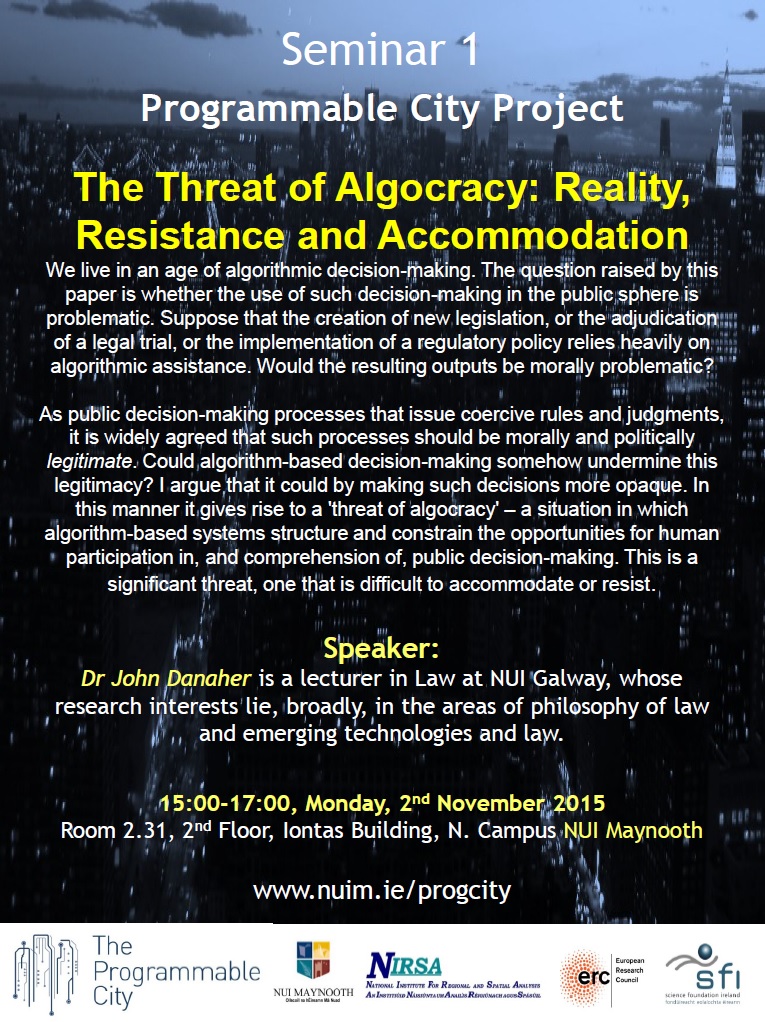
Seminar – Smart Cities and the Secret Life of Objects. (In)Visibility at Glasgow, Curitiba and Bristol’s initiatives.

We are delighted to welcome Dr. André Lemos to Maynooth on Wednesday 25th November at 3pm, Iontas Building, room 2.31 for the second of our Programmable City seminars this semester.

Dr. André Lemos has a PhD in Sociology (Université René Descartes, Paris V, Sorbonne, 1995), and is a Full Professor and the Director of Lab404 – Digital Media, Networks and Space Lab at Faculty of Communication, Federal University of Bahia (UFBA), Brazil. He is presently a visiting scholar at NIRSA, National University of Ireland, Maynooth, with a research grant from CAPES Foundation (Brazilian Ministry of Education). His research is on cultural and communicational aspects of objects on Smart Cities, Internet of Things and Big Data initiatives.

The session will introduce the topics of invisibility of info-communicational objects in smart city initiatives. It will focus on the social/political dimensions of digital objects’ invisibility in everyday life, showing how they mediate and act upon human experience.

ProgCity_Seminar_3_2_AndreLemos

John Danaher – The Threat of Algocracy: Reality, Resistance and Accommodation

On November 2nd Dr. John Danaher visited the Programmable City Project and delivered a seminar on Algocracy, providing a juridical and philosophical perspective on how algorithms affect the legitimacy of decision-making processes.

The talk was extremely well-received, and this video of the event offers an account of the agency of algorithms, their threats, opacity and the possible ways to resist and “accommodate” them.

Seminar – The Threat of Algocracy: Reality, Resistance and Accommodation

We are delighted to welcome Dr. John Danaher to Maynooth on Monday 2nd November at 3pm, Iontas Building room 2.31 for the first of our Programmable City seminars this semester.

Dr. John Danaher is a lecturer in Law at NUI Galway. His research interests lie, broadly, in the areas of philosophy of law and emerging technologies and law. In the past, he has published articles on human enhancement, brain-based lie detection, the philosophy of punishment and artificial intelligence. He maintains a blog called Philosophical Disquisitions, and he also writes for the Institute for Ethics and Emerging Technologies.

The session will introduce the topic of algorithmic decision-making, exploring the issues related to use of such decision-making in the public sphere is problematic and to how it affects the moral and political legitimacy of the decision-making process.

ProgCity_Seminar_3_1_JohnDanaher

New paper: Digital Turn, Digital Geography?

James Ash, Rob Kitchin and Agnieszka Leszczynski have published a new paper entitled ‘Digital Turn, Digital Geography?‘ available as Programmable City Working Paper 17 on SSRN.

Abstract

In this paper, we examine the relationship between the digital and geography. Our analysis provides an overview of the rich scholarship that has examined: (1) geographies of the digital, (2) geographies produced by the digital, and (3) geographies produced through the digital. Using this material we reflect on two questions: has there been a digital turn in geography? and, would it be productive to delimit ‘digital geography’ as a field of study within the discipline, as has recently occurred with the attempt to establish ‘digital anthropology’ and ‘digital sociology’? We argue that while there has been a digital turn across geographical sub-disciplines, the digital is now so pervasive in mediating the production of space and in producing geographic knowledge that it makes little sense to delimit digital geography as a distinct field. Instead, we believe it is more productive to think about how the digital reshapes many geographies

Keywords: digital, geography, computing, digital turn, digital geography

The paper is available for download here.

Data and the City workshop, Session 5 videos

The final set of papers in the Data and the City workshop were a great way to end to a fantastic event. The full catalogue of videos are listed on our Project Videos page and can be found through our Vimeo account. Thanks again for all the attendees for making this year’s workshop such a resounding success.

Data Issues

Smart City, Surveillance City: human flourishing in a data-driven urban world

David Murakami Wood, Associate Professor, Canada Research Chair (Tier II) in Surveillance Studies, Department of Sociology and Cross-Appointed in the Department of Geography, Member of the Surveillance Studies Centre, Queens University, Kingston, Ontario, Canada

Abstract
‘Smart cities’ are characterized by pervasive and distributed sensor networks generating big data for forms of centralized urban management, drawing together such previously unconnected infrastructural systems as video surveillance, meteorological stations, traffic lights and sewage systems. Although presented as largely civic, corporate and managerial, these schemes have a parallel history in military strategic thinking and policing, from crime mapping and predictive policing models, to new forms of urban warfare involving forms of distributed sensor platforms, and computer analytics, to enable forces to get a ‘clear picture’ of the complexities of the urban landscape and its inhabitants. In some cases, these have come together in overt ways, for example in the new ‘Domain Awareness’ initiatives in Oakland, California, and in New York which extends existing port security projects way beyond the military maritime ‘domain’ into the surrounding city and its governance.

Drawing on work in philosophy, science and technology studies, geography and surveillance studies, this paper considers the smart city as the archetypical urban form of the data-driven ubiquitous surveillance society. The paper considers the place of human rights in a broad sense, not simply privacy but also equity, access to services and justice, and ultimately, after Spinoza and Deleuze, the capacity of diverse human beings to flourish, in cities in which people are increasingly monitored, categorized and managed as logistical flows. It suggests some directions from the practices of bottom-up, citizen-centered city hacking initiatives and maker-spaces, but cautions that such practices are already subject to corporate capture and rebranding. The paper concludes that if smart cities are to be a way that big data can serve human flourishing, they need to be detached from narrow techno-economistic purposes and more truly refounded in social-ecological thinking, and this means dismantling many of the surveillance logics that underpin smart cities.

Michel Foucault and the smart city: power dynamics inherent in contemporary governing through code

Francisco Klauser, Assistant Professor, Faculté des lettres et sciences humaines Institut de géographie, Neuchâtel University

Abstract
Drawing upon Michel Foucault’s approach to power and governmentality, the paper explores the regulatory dynamics inherent in contemporary data-driven forms of regulation and management-at-a-distance of urban systems. More specifically, channelled through Michel Foucault’s concept of ‘security’, the paper portrays ‘governing through data’ not only as fundamentally reality-derived, relative and plural in scope and scale, but also as inherently flexible and fluid in aim and functioning. This in turn raises a series of critical questions with regard to the novel possibilities of differentiation and prioritisation, the actual adequateness, and the very implications of contemporary governing through data.

Empirically speaking, the paper focuses on the study of two high-profile pilot projects in Switzerland in the field of smart electricity management: iSMART and Flexlast. Both projects rely on massive efforts of data generation, interconnection and analysis, thus allowing the critical investigation of the rationales and problems inherent in the management of urban systems through data.

Crime Data and Analytics: Accounting for Crime in the City

Teresa Scassa, Canada Research Chair in Information Law, Faculty of Law, University of Ottawa

Abstract
Crime data are a record of incidents of crime. Such data are routinely compiled by police forces and feed into regional and national crime statistics. Crime data are relied upon in various narratives of crime in society. They are made selectively publicly available as open data and are also increasingly used in visualizations such as urban crime maps. Yet the nature of these data makes uncritical reliance upon them problematic. This paper explores the limits of crime data 21 the constraints on open data as crime data, and the deficiencies of visualizations of crime based on this data. It considers some of the practical, legal and institutional challenges of both expanding and improving these data.

New paper: Locative media and data-driven computing experiments

Sung-Yueh Perng, Rob Kitchin and Leighton Evans have published a new paper entitled ‘Locative media and data-driven computing experiments‘ available as Programmable City Working Paper 16 on SSRN.

Abstract

Over the past two decades urban social life has undergone a rapid and pervasive geocoding, becoming mediated, augmented and anticipated by location-sensitive technologies and services that generate and utilise big, personal, locative data. The production of these data has prompted the development of exploratory data-driven computing experiments that seek to find ways to extract value and insight from them. These projects often start from the data, rather than from a question or theory, and try to imagine and identify their potential utility. In this paper, we explore the desires and mechanics of data-driven computing experiments. We demonstrate how both locative media data and computing experiments are ‘staged’ to create new values and computing techniques, which in turn are used to try and derive possible futures that are ridden with unintended consequences. We argue that using computing experiments to imagine potential urban futures produces effects that often have little to do with creating new urban practices. Instead, these experiments promote big data science and the prospect that data produced for one purpose can be recast for another, and act as alternative mechanisms of envisioning urban futures.

Keywords: Data analytics, computing experiments, locative media, location-based social network (LBSN), staging, urban future, critical data studies

The paper is available for download here.