Seminar 3: Sustainable Connected Cities and the London Living Labs Project

The Programmable City Project is happy to welcome Dr David Prendergast who will discuss Sustainable Connected Cities and the London Living Labs Project.

Time: 16:00 – 18:00, Wednesday, 19 February, 2014

Venue: Room 2.31, 2nd Floor Iontas Building, North Campus NUI Maynooth (Map)
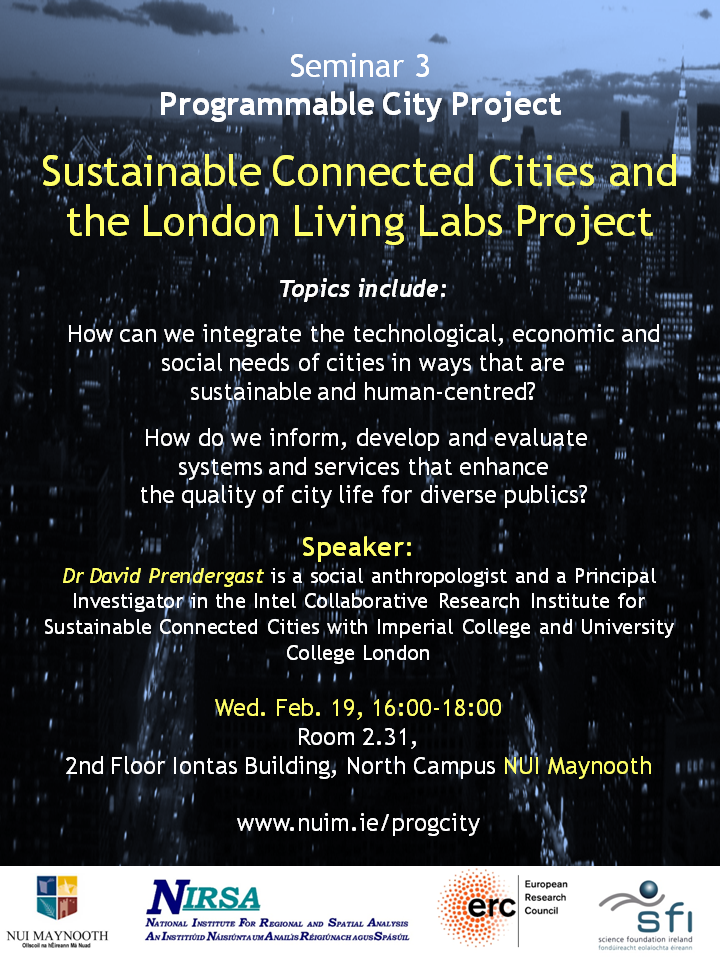
ProgCitySeminar3-poster-FINAL

Abstract: Cities offer many opportunities to innovate with technologies, from the infrastructures that underlie the sewers, to computing in the cloud. How though can we integrate the technological, economic and social needs of cities in ways that are sustainable and human-centred? How do we inform, develop and evaluate systems and services that enhance the quality of city life for diverse publics? This talk discusses the approach taken by the Intel Collaborative Research Institute for Sustainable Connected Cities and provides an overview of key projects including the ambitious London Living Labs programme conducted in association with the UK Future Cities Catapult.

Bio: Dr David Prendergast is a social anthropologist and a Principal Investigator in the Intel Collaborative Research Institute for Sustainable Connected Cities with Imperial College and University College London. He also holds the position of Visiting Professor of Healthcare Innovation at Trinity College Dublin. His research over the last fifteen years has focused on later life-course transitions and he has authored a number of books and articles on ageing, health, technology and social relationships. During his career David has been involved in several major research projects including: a multi-year ethnography of intergenerational relationships and family change in South Korea; the provision of paid home care services in Ireland; a three year ESRC study into death, dying and bereavement in England and Scotland; and Intel’s Global Ageing Project which explored the expectations and experiences of growing older around the world. After receiving his PhD from Cambridge University, Dr Prendergast held research posts at the University of Sheffield, and Trinity College Dublin.

Presentation at Code Acts in Education

Yesterday, Rob Kitchin presented a paper – Code Acts in Code/Space: Making Sense of Software Mediated Education – at Code Acts in Education, an ESRC seminar at the University of Stirling.  The programme is at http://codeactsineducation.wordpress.com/seminars/  Slides from the talk are below.  The event was very thought provoking and if you’re interested in the topic then there are five more seminars to follow.  Visit the website for details and how to register.

New book submitted and into production: The Data Revolution

Rob Kitchin has just submitted the final draft of a new book — The Data Revolution: Big Data, Open Data, Data Infrastructures and Their Consequences — to Sage and it’s moved into production.  The chapter titles are below and the book will be published later in the year.

Preface
1.  Conceptualising data
2.  Small data, data infrastructures and data brokers
3.  Open and linked data
4.  Big data
5.  Enablers and sources of big data
6.  Data analytics
7.  The governmental and business rationale for big data
8.  The reframing of science, social science and humanities research
9.  Technical and organisational issues
10. Ethical, political, social and legal concerns
11. Making sense of the data revolution
References

Lecture: The Real-Time City? Big Data and Smart Urbanism

Principal Investigator on the Programmable City project, Professor Rob Kitchin, will deliver a lecture titled ‘The Real-Time City? Big Data and Smart Urbanism’ Friday February 28 in Oxford, as a part of the OII Bellwether Lectures.

Abstract

‘Smart cities’ is a term that has gained traction in academia, business and government to describe cities that, on the one hand, are increasingly composed of and monitored by pervasive and ubiquitous computing and, on the other, whose economy and governance is being driven by innovation, creativity and entrepreneurship, enacted by smart people. This paper focuses on the former and, drawing on a number of examples, details how cities are being instrumented with digital devices and infrastructure that produce ‘big data’. Such data, smart city advocates argue enables real-time analysis of city life, new modes of urban governance, and provides the raw material for envisioning and enacting more efficient, sustainable, competitive, productive, open and transparent cities. The final section of the paper provides a critical reflection on the implications of big data and smart urbanism, examining five emerging concerns: the politics of big urban data, technocratic governance and city development, corporatisation of city governance and technological lock-ins, buggy, brittle and hackable cities, and the panoptic city.

Details

  • Friday 28 February 2014 17:00 – 18:30
  • Lecture Theatre, Ioannou Centre for Classical and Byzantine Studies, 66 St Giles, Oxford, OX1 3LU
  • Please email your name and affiliation to events@oii.ox.ac.uk or telephone +44 (0)1865 287210.

Cross-posted from the Oxford Internet Institute.

Podcast: Aphra Kerr at Coding Play / Crafting Code

Talk presented by Aphra Kerr (Sociology, NUI Maynooth) at the second Programmable City Seminar.

Coding Play / Crafting Code in the City
Wednesday, 15 January 2014, 16:00 – 18:00

Aphra Kerr is senior Lecturer and researcher in social studies of technology and media. She also teaches courses on games and play, and culture and everyday life. She has extensive research experience on the production, use and regulation of digital media, especially digital games, SNS (social networking sites) and animation, as well as the changing nature of broadcasting in the digital age. Her current research projects include ‘Cultural Production in the Digital Age’ (NSF funded network) and she is currently writing ‘Global games and transnational work’ (book under contract). For the past ten years she has been involved in running gamedevelopers.ie, a community voluntary website for the games industry in Ireland.

Podcast: Andrea Magnorsky at Coding Play / Crafting Code

Talk presented by Andrea Magnorsky (Organiser and Co-founder of GameCraft and BatCat Games) at the second Programmable City Seminar.

Coding Play / Crafting Code in the City
Wednesday, 15 January 2014, 16:00 – 18:00

Andrea Magnorsky is Senior software developer with many years of experience building a variety of products, including CRM, eCommerce, Financial, and Video Games. She is an advocate of test-driven development, and object-oriented design principles, as well as a part time lecturer on Games Programming. She is organisor and Co-founder of GameCraft Foundation which organises weekend game jams both in Ireland and internationally and co-founder of BatCat Games. BatCat Games are currently working on Honorbound, a 2D, side-scrolling beat ‘em up game focused on combat in a feudal Japanese setting. Their first game P-3 Biotic is a space shooter available on PC from GetIrishGames.ie.