Monthly Archives: November 2016

“Creating Smart Cities” workshop videos: Session 3

We are happy to share the third set of videos from The Programmable City’s recent workshop “Creating Smart Cities”, Session 3: Privacy and security concerns in smart cities. [Session 1 here, Session 2 here]

Pseudonymisation and the Smart City: Considering the General Data Protection Regulation

Maria Murphy, Maynooth University

Abstract
The great promise of smart cities is tempered by the very real risks associated with the large-scale collection, sharing, and analysis of data. As the General Data Protection Regulation – set to apply from May 2018 – attempts to respond to the modern data processing environment, this paper considers the implications of the new Regulation for the smart city. In particular, this paper examines the introduction of a “privacy by design” mandate and considers the endorsement of pseudonymisation as a privacy enhancing technique. The “positive-sum” pro- privacy and pro-progress philosophy of the privacy by design approach would appear, on first inspection, to perfectly address the challenges of the smart city. In reality, of course, while privacy by design offers a helpful “mindset”, it is certainly not a panacea.

From start to smart: A 100 smart cities but where are the citizens?

Ayona Datta, King’s College London

Abstract

In January 2016, the Indian government announced the first 20 winners of its smart cities challenge. This is the start of the journey for these cities to becoming smart. As part of this challenge, each city developed a pan-city and area-based proposal to reflect their local context, resources, and priorities of citizens. At the end of this journey a total of 100 small to medium cities in India would have retrofitted their chosen urban areas with smart infrastructure, transport, housing and governance. The end of this journey for the 100 cities will seemingly mark the beginning of India’s new urban age.
In this paper, I search for the elusive citizens in India’s ambitious national urbanization programme of creating 100 Smart Cities. Examining the different smart city proposals submitted by the nominated cities for the smart cities challenge, I argue that each of these seek to present particular visions, imageries and fantasies of performing the smart citizen. These can be roughly presented as 1) Fast-tracked citizens- the near overnight production of a mega base of urban ‘population’ in each city for the mandatory citizen consultation in the smart city challenge. 2) Acquiescent citizens who contribute to open data, engage in e-governance and increase ‘civic discipline’ through citizen surveillance 3) Entrepreneurial citizens who contribute to economic growth and prosperity of the smart city, who are framed as careerist and heroic, but who individually and collectively take the risk and precarity of speculative markets on their shoulders.
Through these three figures, this paper will ask how the ‘citizen’ has become the biggest urban fantasy of India’s Smart city challenge, and what are the consequences of this fantasy. The answer to these questions will have profound consequences for the understanding of India’s urban futures and the urbanization of citizenships in the region.

[Video not available]

The Privacy Parenthesis: The Structural Transformation of the Private Sphere

Leighton Evans, University of Brighton

Abstract

The “Snowden Revelations” that revealed the extent of surveillance of everyday citizens in everyday life have been a focal event for discussion on the mediation of privacy itself in the digital age. As technological development moves towards the everyday integration of things in the “Internet of Everything”, this chapter focuses upon the shifting sense of privacy in spaces that were once considered “private” in light of the extraordinary levels of data collection continuing unabated in everyday life. To do this, I use the metaphor of parenthesis as a way of conceptualising the separateness of the private realm from other realms of human activity. The use of parenthesis here is in a dual articulation; parenthesis articulates both the separate nature of the private and problematizes the modern conception of privacy as a separate, private space linked to property ownership that is being challenged by digital media. Discussions on the “end of privacy” can be assimilated into this metaphor; in essence, this approach rejects the claim to an end of privacy but argues that privacy itself (here, the very nature of what lies in parenthesis) is changing from a spatial privacy to another, non-spatial form. This non-spatial privacy is characterised as intentional, mannered and performed, and is reflected upon with reference to the development of the smart city as a concept and phenomenal space.

From data subjects to data producers: negotiating the role of the public in urban digital data governance

Christine Richter (University of Twente), Linnet Taylor (Tilburg Institute for Law, Technology, and Society), Shazade Jameson (Independent), and Carmen Pérez del Pulgar (Institut de Ciència i Tecnologia Ambientals)

Abstract

Today’s smart city programs and systems bring private and public sector actors together in ways that are creating streams of data about citizens, and these streams inhabit a legal and practical grey area between the public and private domains. Digital traces from sensors and digital communications tools can be merged and linked with official records, volunteered data from apps, social media, and citizen feedback systems in ways that have implications for privacy and data protection. City authorities are not yet addressing the ethical implications of today’s data governance decisions: seemingly inconsequential data often contain intimate behavioural and locational traces, and all digital data produced by people have a long half-life, gaining in both financial value and sensitivity over time. As data become big data, existing rules and norms (such as the Fair Information Practice Principles) become unworkable, and regimes developed for analogue data are not easily updated for the era of ubiquitous computing, profiling and artificial intelligence. This creates new questions for urban governance: what elements of public life are private processes, and how can they be balanced with the benefits of sharing to create public goods, such as health and education? Cities are currently on the cusp of understanding the breadth of applications and potential of digital data for governance and functionality in urban space: city governments are likely to become an important hub for data exchange in the future, and to form part of the emerging international data market. How can city governments make informed choices about the kinds of infrastructures they set up, how can they understand the longer-term implications of those choices, and how do different infrastructures and processes to do with data build differing relationships between cities and citizens?
Smart Docklands in a word, and smart city bingo

A couple of weeks ago I published a list of words that members of the Smart Dublin Advisory Network felt represented qualities they hoped Smart Dublin would fulfil.  At a recent meeting about a proposed Smart Docklands initiative attendees were asked to perform the same task – use one word to describe a desirable quality for the area/initiative.  Here is that list of aspiration words:

Co-creation                  Innovation                  Collaboration
Best practice               Showcase                    Testbed
Quality of Life             Community                 Engagement
Smart energy              Telecoms                     Internet of Things
Data                              Open                            Bright
Intelligent                    Optimized                    Autonomous system
Sustainability              Safety                           Resource efficient
Industry                       Startups                       Opportunity
Alignment                    Integrated                   Deploy and forget
Electricity                     Battery                         Energy
Connectivity                Smart mobility

While there is some overlap in the lists, it’s interesting to note the differences between the aspirations expressed at the two meetings.

Here are the words in the Smart Dublin list that are not in the Smart Docklands one:

Networking, Collaborative, Cooperation, Sharing, People, Well-being, Accessible, Diversity, Insight, Problem-solving, Strategic, Joined-up, Agile, Transformative, Future-proofing, International, Socio-technical, Curiosity, Easy

And here are the words in the Smart Docklands list not in the Smart Dublin one:

Co-creation, Best practice, Showcase, Smart energy, Telecoms, Internet of Things, Open, Bright, Intelligent, Optimized, Autonomous system, Resource efficient, Industry, Opportunity, Alignment, Deploy and forget, Electricity, Battery, Energy, Smart mobility

And here is the overlap:

Innovation, Collaboration, Testbed, Quality of Life, Community, Engagement, Data, Sustainability, Safety, Startups, Integrated, Connectivity

Perhaps not unsurprisingly the Smart Docklands list has more economic aspirations, but does still contain ambitions concerning community, engagement, quality of life and sustainability.  Adding the two list together, I sense, provides a kind of ‘smart city bingo’ – a full house of smart city goals.

Thanks for Jamie Cudden and Réka Pétercsák for compiling and sending the Smart Docklands list to me.

Rob Kitchin

Post advertised: Postdoc on ProgCity project

We are seeking a postdoctoral researcher (14 month contract) to join the Programmable City project.  The researcher will critically examine:

  • the political economy of smart city technologies and initiatives; the creation of smart city markets; the inter-relation of urban (re)development and smart city initiatives; the relationship between vendors, business lobby groups, economic development agencies, and city administrations; financialization and new business models; and/or,
  • the relationship between the political geography of city administration, governance arrangements, and smart city initiatives; political and legal geographies of testbed urbanism and smart city initiatives; smart city technologies and governmentality.

There will be some latitude to negotiate with the principal investigator the exact focus of the research undertaken. While some of the research will require primary fieldwork (Dublin/Boston), it is anticipated it will also involve the secondary analysis of data already generated by the project.

More details on the post and how to apply can be found on the university HR website.  Closing date: 5th December.

Smart Dublin – in one word

The first Smart Dublin Advisory Network meeting took place on the 12th October in the Mansion House.  The plan is for the network to meet every six months to help guide the work of Smart Dublin as it develops and implements its strategy and programmes.  The first meeting mainly focused on introducing Smart Dublin and undertaking some initial workshop exercises to brainstorm initial ideas and feedback and to do so preliminary backcasting.  The first task was a quick introduction and for each person to say in one word a quality they hoped Smart Dublin would fulfil.  Here’s a list of those aspirational words – which I have grouped into triplets – a list against which to judge over the next few years how successful Smart Dublin has been.

Connectivity              Networking              Integrated
Collaborative            Cooperation             Sharing
People                       Community              Engagement
Well-being                 Safe                           Quality-of-life
Accessible                 Sustainable              Diversity
Data                           Insight                       Problem-solving
Strategic                    Joined-up                  Agile
Transformative        Future-proofing       International
Innovation                Start-ups                   Testing
Socio-technical        Curiosity                    Easy

Interestingly, efficiency, economy and open – which are three of the four key terms that have to date underpinned Smart Dublin’s work (along with engagement) – were not suggested. Personally, I think it’s a fascinating list in terms of what it prioritizes as key attributes of a successful smart city and it would be interesting to compare this list to other lists produced by stakeholder groups in other cities.  A brief post about the advisory board meeting and the Smart Dublin showcase that followed its first meeting can be found here.

Rob Kitchin

Impressions of Songdo, an urban growth machine in progress

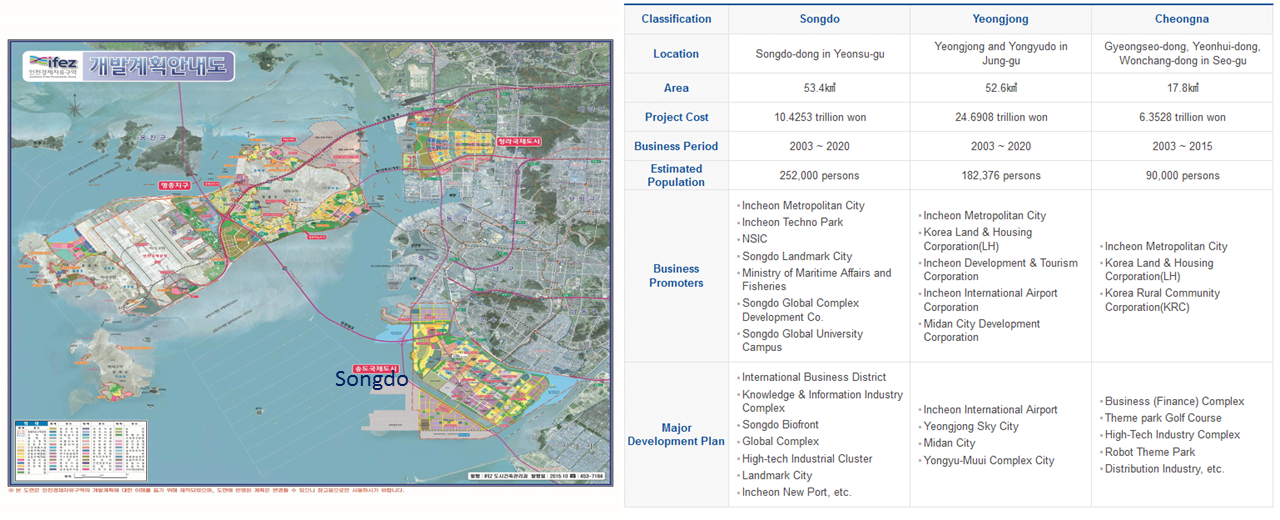
On September 30th/October 1st, while on a trip to South Korea, I visited Songdo, the much discussed smart city development built in the Incheon Free Economic Zone (IFEZ) at the edge of the Seoul metropolitan area.  The IFEZ, initiated in 2003, consists of three large-scale developments – Songdo (international business district, with a focus on research, education, bio-tech, conferencing), Yeongjong (aviation and logistics hub, tourism), and Cheongna (finance, component manufacturing, robotics, shopping and tourism), much of it built on reclaimed land.

My exploration mainly consisted of a long wander around Songdo and a visit to the IFEZ Promotion Centre on 33rd floor of G-tower.  Unfortunately, the exhibition in the Compact Smart City museum was ‘closed for construction’ and I also failed to see the U-City Vision at Tomorrow City as the entire complex seemed to be closed (I have a feeling that it might be permanently closed as the website was last updated in May 2010).

Songdo

While Songdo is perhaps best known in the urban studies literature as model smart city and an example of testbed urbanism on a grand scale, my sense is that its creation really has to be contextualised with respect to IFEZ as it is predominately an economic development initiative aimed at driving domestic growth and establishing South Korea as a North East Asian hub for particular industries and thus consolidating its position as a key player in the global economy.
Seen from this perspective, the focus on creating a smart city is an implementation strategy designed to attract investment capital, anchor tenants, and global workers, with a side benefit of creating a potential exportable model of development.  Indeed, the smart city is one of four such implementation strategies used by IFEZ to bring the vision of being a ‘global business frontier’ to life, the others being: creating ‘a global economic platform’, becoming a ‘hub of service industries’ and a ‘hub of convergence’.

These strategies have been quite successful in attracting Korean and global investment, with over $US 8.3 billion being invested in the IFEZ by June 2016.  This has led to rapid growth.  In 2003 the population of the IFEZ (3 areas) was 25,778; by June 2016 it stood at 253,465.  Of these, 4,281 were international residents.  Songdo’s population exceed 100,000 in early 2016.  In the same period the number of companies operating in the IFEZ had grown to 1,737, of which 80 were foreign-owned, and there were 4 international universities and 14 international organizations who had opened campuses/offices in the IFEZ, including branches of the United Nations.  The plan is that by 2030 investment will have reached $US 15 billion, the number of foreign invested companies will have reached 150, the number of international organizations 150, the number of international universities 10, and the population will have grown to 536,000, of which 60,000 will be international residents.

Songdo 2

To aid such growth, the IFEZ has a number of development, planning and social policies.  For example, each district has their own design theme, with Songdo specializing in ‘night landscape, high end architecture landscape, mountainous skyline and waterside network’, along with the theme of being a smart city, or what they have termed ‘U-City’, an intelligent city that utilizes ubiquitous computing to manage urban infrastructures and city services.  In the IFEZ case, the U-City seeks to provide the coordinated management of transportation, environment, crime prevention, fire prevention, and facility management in an integrated manner across the three areas from a single control room.  In terms of social policies this includes trying to produce a ‘trouble free life for foreign residents’, including a ‘real-estate investment immigration system’, in which non-Korean investors are given resident status and after five years permanent residence status.

ucity centre

Recently they have established a plan to develop the IFEZ U-City model into what they term ‘the K-Smart City model’ to ‘more aggressively reinforce its presence in the overseas market.’  Utilising a public cloud system to ‘to securely store the massive amount of information flowing in from the CCTVs and sensors installed across the city’ and an approach to ‘drastically reducing construction and maintenance costs’, this model, it is anticipated, will not only ‘enhance the quality of life of citizens but also serve as a new growth engine as an added-value industry.’  In other words, the IFEZ wants to firmly establish itself as a model of smart city development and governance and to export this model, their expertise and new technologies globally, as made clear by Government official Kim Jong-won of the IFEZ U-City Division: “We plan to develop the knowhow, technology, and expertise regarding the construction of IFEZ and U-City into a brand and commercialize it on a global level.” Songdo is thus a means to showcase top-tier infrastructure and to create an exportable set of knowledges and technologies.

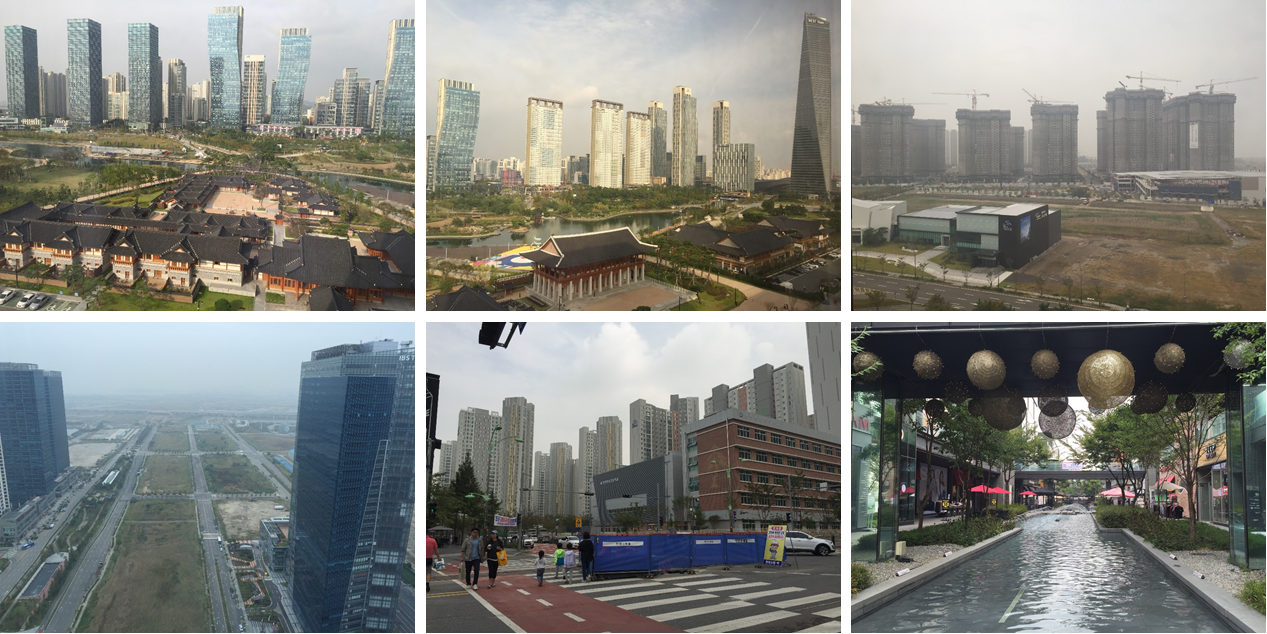
So, what were my impressions of the Songdo?  Having been led to believe that the place is half-built and mostly empty, it is clear that while one section is under-construction a substantial chunk is complete and occupied and all the major infrastructure (in terms of roads, rail, air, energy) are in place.  The part that is complete while quite quiet during the day is reasonably busy during the night with lots of people on the street and in the park, loads of kids playing in courtyards of tower blocks, and there are hundreds of restaurants and shops.  As the empty lots attest it’s a project in development, but far from being a ghost town.  Indeed, 13 years ago there was little but reclaimed land, but now there are over 100,000 people living in Songdo and in the areas that are complete the built environment feels relatively mature.

However, my sense was that it’s all very new, clean and wealthy, and there was little organic about the city – it has clearly been planned and developed to a masterplan, with centrally managed clustering of shops, restaurants and services, and some signature architecture around Central Park.  Moreover, the nascent city is a gated community at city-scale.  Given that the land was reclaimed there was no local community to displace and the cost of living in the private apartment buildings works to exclude lower-income households.  Indeed, Songdo is reputed to be one of the largest privately developed and financed urban developments globally and it aims for a certain degree of exclusivity that will attract additional international investment.

As for the smart city technologies these are difficult to spot, which is no surprise given they are designed to work in the background.  As such, the place does not particularly feel very smart (but rather a newly constructed city district) and since I struggled to get online outside the hotel I couldn’t access what information is made publicly available.  Moreover, what is highlighted in the Promotions Centre might have been pushing the smart city envelope in the mid-2000s but is now pretty middle of the road (real-time passenger information, sensor networks and CCTV, smart parking, traffic and accident information, e-government services, energy-efficient buildings, urban control room).

My overall impression then is that Songdo is more about economic development, free trade, global capitalism, real-estate development, cities as a target market for tech development, and gated community at a city scale, than it is about creating sustainable, diverse and smart communities and citizens.  And despite the global financial crisis it’s making a pretty good fist of the former, having now seemingly gained enough critical mass in terms of investment, infrastructure, companies and population to become an urban growth machine.  I’m not convinced, however, that this is the kind of smart city that other places should seek to emulate given it’s the vision of private interests largely for the benefit of private interests.

Rob Kitchin

A number of the quotes in this blog post are from the IFEZ journal (Sept/Oct 2016, vol 71).

Post-script – I’ve had a search around after I posted this piece.  There are a number of academic articles/book chapters concerning the development of Songdo, including:

Carvalho, L. (2012) Urban competiveness, U-city strategies and the development of technological niches in Songdo, South Korea. In Bulu, M. (ed) City competitiveness and improving urban subsystems. Information Science Reference, Hershey, PA. pp. 197-216.

Halpern, O., LeCavalier, J., Calvillo, N. and Pietsch, W. (2013) Test-Bed Urbanism. Popular Culture 25(2): 272-306.

Kuecker, G.D. (2013) Building the Bridge to the Future: New Songdo City from a Critical Urbanism Perspective. Paper prepared for the workshop: New Songdo City and South Korea’s Green Economy: An Uncertain Future.

Kim, J.I. (2014) Making cities global: the new city development of Songdo, Yujiapu and Lingang. Planning Perspectives 29(3): 329-356

Kim, C. (2010) Place promotion and symbolic characterization of New Songdo City, South Korea. Cities 27(1): 13-19.

Shin, H., Park, S.H. and Sonn, J.W. (2015) The emergence of a multiscalar growth regime and scalar tension: the politics of urban development in Songdo New City, South Korea.  Environment and Planning C 33(6): 1618-1638

Shwayri, S.T. (2013) A Model Korean Ubiquitous Eco-City? The Politics of Making Songdo. Journal of Urban Technology 20(1): 39-55.