Book launch: The Data Revolution and others

Mark Boyle, Chris Brunsdon & Rob Kitchin invite you to a BOOK LAUNCH Thursday 26th, February 2015, 4.30pm, Maynooth University Bookshop, North Campus

Using the story of the “West and the world” as its backdrop, this book provides for beginning students a clear and concise introduction to Human Geography, including its key concepts, seminal thinkers and their theories, contemporary debates, and celebrated case studies.

“An excellent textbook for introductory courses in Human Geography.” Prof. Patricia Wood, York University, Toronto

“In this textbook, Mark Boyle combines his broad and deep understanding of the discipline of Human Geography with his great passion and enthusiasm for education and teaching.”  Prof. Guy Baeten, Lund University

This is an excellent and student-friendly text from two of the world leaders in spatial analysis. It shows clearly why the open source software R is not just an alternative to commercial GIS, it may actually be the better choice for mapping, analysis and for replicable research. Prof.  Richard Harris, Bristol University

This is a vital primer to what is ‘Big’ about geocomputation: new data, innovative methods of analysis, new geographic information technologies and, above all, an over-arching rethink of how we represent geography. Prof. Paul Longley, UCL

The Data Revolution provides a synoptic and critical analysis of big data, open data, and data infrastructures.

“Anyone who wants to obtain a critical, conceptually honed and analytically refined perspective on new forms of data should read this book.”  David Beer, University of York

Funny, engaging, fast-paced and hugely enjoyable … a unique combination of comedy, both gentle and black, and Grand Guignol murder and mayhem.”  Michael Russell, author of The City of Strangers

ALL WELCOME
New paper: Continuous geosurveillance in the smart city

A new paper by Rob Kitchin has been published in DIS Magazine as part of its fascinating ‘Data issue‘.  The paper explores the extent to which geosurveillance is becoming pervasive and routinised and the consequences of such geosurveillance with respect to civil rights and governance, and is accompanied by some original art by Mark Dorf (also used in the site banner above)  It starts thus:

“For the past couple of decades there has been a steady stream of analysis that has documented the ways in which the rollout of new digital and networked technologies have enabled increasingly pervasive and extensive forms of state and corporate surveillance. Such technologies have the capability to capture and communicate data about their use; simultaneously a wealth of sophisticated software has been developed that processes and acts on such data in automated, autonomous, and automatic ways. Importantly, the use of embedded GPS, sensors, and digital cameras are enabling location and movement to be tracked, facilitating extensive geosurveillance of people and places.

Continuous geosurveillance relies on the production of spatial big data, and in particular the notion of the “smart city” takes center stage, that is, urban landscapes that can be monitored, managed and regulated in real-time using ICT infrastructure and ubiquitous computing. Such instrumented cities are promoted as providing enhanced and more efficient and effective city services, ensuring safety and security, and providing resilience to economic and environmental shocks, but they also seriously infringe upon citizen’s privacy and are being used to profile and socially sort people, enact forms of anticipatory governance, and enable control creep, that is re-appropriation for uses beyond their initial design.

What follows is a consideration of the unfettered rush to create “smart cities” that is sensitive to the risks involved in extensively monitored urban landscapes. Are too much data about people and places being generated by public and private institutions and used to profile, sort, and sift in pernicious ways? In the rush to create smart cities is the privacy and freedom we expect in liberal democracies being eroded? Perhaps most alarming, are we creating cities that represent the interests of a select group of corporations and technocrats, rather than producing ones that represent the best interests of all citizens? ….”

Industrial Heritage: Software enabled preservation of dispersed and fragile knowledge in miniature.

Developments in software and digital technology have had wide ranging impacts on our leisure time, from movies on demand on our mobiles, internet on public transport and the ‘selfie’  saturated world of social media. Yet advancements in technology have also reached creative activities that are often considered far from mainstream and groups of individuals, who though they share a common interest, may pursue their leisure activity individually and in relative isolation.

One such social group is that of model railway enthusiasts. For these collectors, builders and hobbyists the developments in software have enabled fundamental changes to the way they explore and express their interests.  Geographically dispersed and relatively few in number (estimated in the low hundreds in Ireland) software has offered a means of augmenting the traditional physical locations of interaction, socialising and knowledge sharing. Software and connectivity have enabled a network of online interactions that has linked individuals more closely with the commercial suppliers and the specialist manufacturers of the models they consume, extending the reach of the community beyond the traditional clubs or shows. It has facilitated efficient access to, and the sharing of, previously inaccessible or unknown historic and practical knowledge regarding even the most obscure topics such as window size and seat positions.  Building upon more traditional sources of historic data such as printed media and journals, software has also enabled the capture of dispersed and divergent forms of data and facilitated their transformation, via computerised production methods, into ready-to-run models with unprecedented levels of physical detail and functionality. Continue reading

Dreaming about the Cloud in rural Ireland

Late last week I, and many others I would presume, were left further behind in the digital era at the stroke of a pen. What my monthly bill cheekily termed broadband was officially no longer! In fact I never really had broadband to begin with, reliant as I am on ancient lines of copper which valiantly struggled to connect me to a quaint legacy telephone exchange deep in rural Wexford. Often it has proven more useful as an indicator of wind speed than a delivery method of zeros and ones, with wind-generated friction on the line reducing those precious few minutes of 1.2 Mbps connectivity still further on stormy evenings. Well in the US the telecoms watchdog, the FCC, has just raised the bar on what can officially be labelled as broadband, state-side at least, by redefining the minimum download speed at 25 Mbps. I can but dream! Continue reading

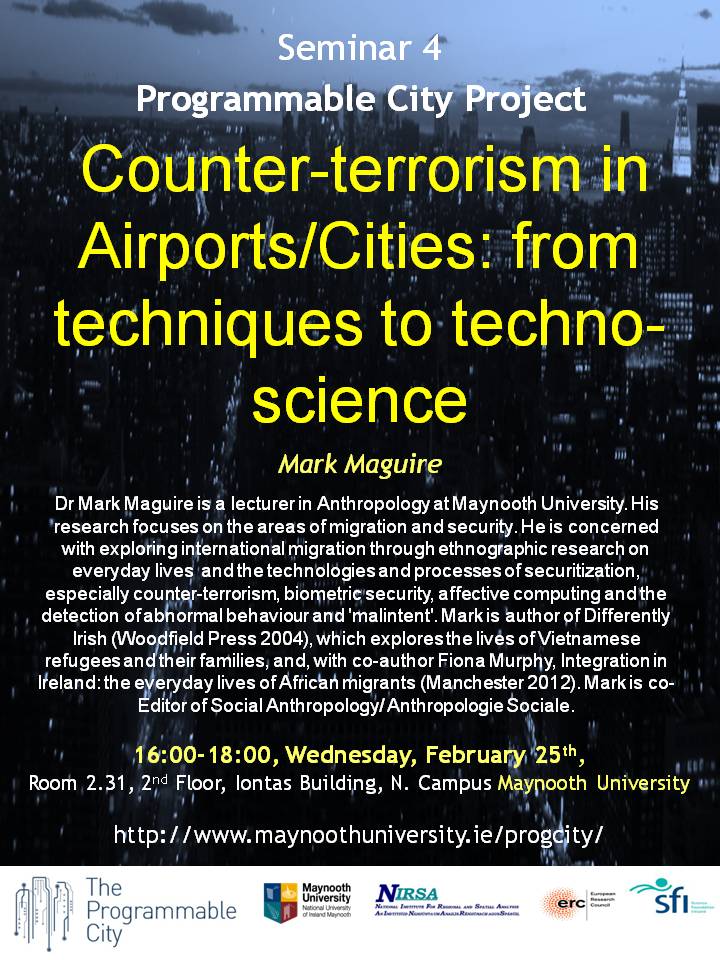
Seminar – Counter-terrorism in Airports/Cities: from techniques to techno-science

We are delighted to welcome Mark Maguire to The Programmable City project on Wednesday 25th February, 4-6pm in room 2.31, Iontas Building, Maynooth University. This is the fourth of our Programmable City seminars this academic year. Mark is a lecturer in Anthropology at Maynooth University. His research focuses on the areas of migration and security. He is concerned with exploring international migration through ethnographic research on everyday lives  and the technologies and processes of securitization, especially counter-terrorism, biometric security, affective computing and the detection of abnormal behaviour and ‘malintent’. Mark is author of Differently Irish (Woodfield Press 2004), which explores the lives of Vietnamese refugees and their families, and, with co-author Fiona Murphy, Integration in Ireland: the everyday lives of African migrants (Manchester 2012). Mark is co-Editor of Social Anthropology/Anthropologie Sociale.

ProgCitySeminarMarkMaguire

Ben Williamson – Programmable Schools? Governing education through code in the smart city

On January 28th 2015, Ben Williamson visited the Programmable City Project and delivered a seminar on “Programmable Schools”. Ben is a lecturer in the School of Education at the University of Stirling. His current research focuses on learning analytics, policy labs, and the emergence of new forms of digital education governance and digital policy instruments. This presentation drew on the ESRC-funded Code Acts in Education project that Ben is currently leading. Continue reading