Rob Kitchin’s latest book The Data Revolution: Big Data, Open Data, Data Infrastructure and Their Consequences was published on August 23rd by Sage. There’s a dedicated website with a bunch of resources (including open access links to related papers and a hyperlinked bibliography), plus a promo video (below). The publisher has made the preface and chapters one (Conceptualising Data) and four (Big Data) open access. The website has a full table of contents and chapter outlines though the title gives a pretty good description as to what it’s about. The book has had a decent amount of advance praise. The site includes details about buying the book, including electronically through just about every format going.
Note – I have received some feedback since last night and have updated the post accordingly. Thanks to those who provided it!
The Republic of Ireland, Department of Public Expenditures and Reform (DPER) launched its first Open Data Pilot Portal data.gov.ie on July 22nd. The new portal was created by INSIGHT Galway who answered the DPER call for tender of January 24, 2014. The following suite of products were delivered on April 7th and officially approved by the Government on July 1st. This is an important milestone.
On the following day, July 23rd, the Government released Ireland’s first Open Government Partnership (OGP) National Action Plan. The newly launched data.gov.ie portal falls within Ireland’s OGP Plan under section 4 entitled: Open Data and Transparency – opening-up Government data for greater accountability, improving public services and achieving economic growth. It was also something civil society, academia and government have been advocating for, for some time.
The first draft of this plan was released at the OGP European Regional Meetings held in Dublin in May of 2014, and part of the package of deliverables listed above are related to Ireland’s May 2013 commitments to join the OGP. The Government also aspires to sign onto the G8 Open Data Charter. The OGP plan was informed by a number of stakeholders from civil society, academia and the public and private sectors. The documentation related to this process is available on the OGP page for Ireland and on the Open Knowledge Foundation Ireland website. There are many strategies in these reports, if implemented, will greatly make government more accessible and transparent to the public.
Subsequently, the DPER invited members of the public service, involved with the production and dissemination of public sector data in Ireland, to attend an information session, held on the 29th of July, to discuss the documents, the portal, to solicit feedback on the development of an open data strategy for the Republic and to seek support. A public briefing will also be held September 8th with civil society stakeholders and the public who have been actively engaged in the production of the OGP DRAFT Plan and engaged in Open Data and open government in Ireland.
This blog post is the first of a three part series on open data.
This post sketches part of the open data landscape for the past 5 years.
The next post will discuss the DPER/INSIGHT documents, the portal and provide recommendations.
The final will discuss the open government plan.
Sketching the Open Data Landscape in Ireland
Members of the Programmable City Project have been actively engaged in the theory and practice of open data and making data accessible in both Ireland and Canada for 15 years. As part of this ERC funded Project researchers are producing open data genealogies and data assemblages for Ireland, Canada and Boston in the US. The following is but a sketch of the open data landscape in Ireland. In the last 5 years much important work has been done prior to the DPER launch and it important to feature some of this work as it provides context to the Irish Open Data Story.
The public sector in collaboration with the private and academic sectors have been advocating for both open data and open government for some time. For example, In June of 2011, National Cross Industry Working Group was formed “to support and inform government in the delivery of their Open Data objectives. [They were] committed to realising Open Data opportunities for Government, society and industry while simultaneously re-enforcing [Ireland’s] international reputation as a global technology hub”. Their Report includes recommendations, many of which were included in the DPER/INSIGHT reports and a history of open data activities from 2009-2011. WG members also held a number of events as part of Open Data Week between Nov. 7-11 in 2011. Shrotly thereafter, on November 17, 2011, the DPER as part of its 2011 Public Sector Reform Plan includes making data more accessible and opening government more broadly. The current DPER/INSIGHT reports are therefore not the first time the government announces open data and open government plans.
data.gov.ie is also not the first portal as other levels of government, civil society and academia, as well as the private sector have: produced their own portals, have integrated portals; have shared some of their own datasets; have added value to some; have produced some civic apps and have helped shape the discourse of openess.
Many of the early public and academic sector data dissemination initiatives, in Ireland would not be considered as pure ‘open data’ according to the Open Definition. Some of the County level portals listed below might not meet all of the open criteria, since many stipulate that data cannot be used for commercial purposes or passed onto third party entities. The Fingal Open Data portal is the exception. These would be classified as open access to data projects. They are nonetheless precursors to the ‘open data’ DPER launch. These initiatives have been sharing their data as part of their normal dissemination practices or as an institutional policy. For example, statistical and geospatial data producing communities in particular are renowned for their good practices in Ireland and internationally.
The following is a selection of open access, open data and transparency initiatives in Ireland:
Kildare Street (launched 2009) makes parliamentary records accessible and records what parliamentarians say and do;
Active Citizen (founded 2010) has been working with andadvocating for Ireland becoming a member of the Open Government Partnership since 2011, and develop. In 2012 an OGP Business Case which included the fostering of an open data ecosystem was provided to DPER. It founded the Open Knowledge Foundation Ireland local group (2013) which became OKF Ireland Chapter (2014);
CKan Open Data Portal (launched September 2013), it is no longer on line. An inventory of close to 200 public sector data initiatives were added into this demo portal during a one day hackathon;
AIRO.ie (All-Island Research Observatory launched 2010), disseminates datasets from agencies both from the North and the South as interactive online graphs and maps and also in an open data store. It was initially the Cross-Border Regional Research Observatory founded in 2006.
Public, Academic and Private Sector Partnership
Dublinked.ie(Launched June 2011), a partnership project which disseminates a variety of static and real time data.
Public & Private Sector
There are far too many open access to data initiatives in Ireland to list here, the DPER/INSIGHT Data Audit Report provides a partial list, organizations like AIRO have created their own inventories which they make accessible in their Data Store, the Irish Spatial Data Exchange(ISDE) has integrated the metadata of a number of important data catalogs, dublinked.ie lists hundreds in their portal and the Ckan portal, now offline, listed close to 200 initiatives in a one day hackathon. The private sector also disseminates data on behalf and with the public sector. ESRI Ireland for examples disseminate data in a number of ways, as products and as web services services. Finally, there is also the GeoPortal.ie which was developed by the Department of Environment, Community & Local Government (DECLG) and Ordnance Survey Ireland (OSi) with guidance and oversight fromIrish public bodies on the Irish Spatial Data Infrastructure (ISDI) project steering committee.
The following is a very small list of how some public sector organization open access to data initiatives disseminate their data:
integrated and interoperability – spatial data infrastructures, and spatial data strategies are integrated web based geospatial data delivery processes that include standards, portals, interoperability and framework data. Geoportal, ESRI, AIRO, EPA, Marine, Fingal, Roscommon, DECLG mentioned earlier and many others have been disseminating their data in this way for quite some time.
terms and conditions – some data are shared according to pre-existing agreements between researcher and research participant (e.g., Irish Qualitative Data Archive);
practices – whereby data that are value added (e.g., cleaned, aggregated, geocoded, mapped, visualized, analyzed) often in partnership with a public sector institution are simply disseminated as data or rendered into maps (E.g., All-Island Research Observatory).
Linked data: data are made discoverable according to linked data principlessuch as the Central Statistics Office.
Shaping the Terrain:
There a number of initiatives that help shape debates on openness and transparency and some of these are:
TheStory.ie sheds light on law, policy and freedom of information in Ireland (based on Gavin’s Blog launched in 2002);
Creative Commons Ireland produces open licences enabling data producers to share their data more openly (founded in 2003);
Coder Dojo builds capacity by teaching people to code and to understand open source and open data (founded in 2011);
advocating open access publishing, Open Access Ireland (committee formed in 2012).
Code for Ireland (launched January 2014), apps are voluntarily created in a hackathon type of environment with open data, or data are produced to address civic issues and these are rendered into apps.
A number of app contests and hackathons have been taking place since 2010.
Indicators and Evaluation
Ireland’s openness has also been ranked according to a number of measures, and these too have inspired action within and outside the public service. These ranking schemes were discussed in an earlier post entitled on Mapping Openness and Transparency.
Research
Finally, there are research projects which are part of a new emerging field called critical data studies, The Programmable City Project being one of the few doing so internationally, and data discovery and semantic interoperability projects such as the INSIGHT Linked Data project based at NUIG.
Open Data Assemblage
The above is by no means complete nor exhaustive list of projects and activities. For instance the open source community; the private sector (e.g., IBM); lawyers, geomaticians, scientists, programmers, journalists, business associations, citizen scientists, and other individuals; are part of this landscape. As are those who provide collaborative working spaces (e.g., T-Cube); sponsors of open data events (i.e., ESRI) or donate space (i.e., the Engine Yard, Facebook); informal virtual server use arrangements, or the library community. Furthermore, only the OGP, EU and OKF are mentioned as international influences, yet there are other national programs (e.g., UK, US), NGOs, standards organizations, and data infrastructures that are a part of this story. A data assemblage analysis will be used as a way to situate these actors in the open data and the data landscape in Ireland in general.
Some motivating factors and issues:
Open data stakeholders prior to the launch of the DPER/INSIGHT documents and the portal, were motivated into action because of a number of issues beyond transparency, efficiency and collaboration. The following is a sample of some of the more high level issues:
the disappointment and missed public benefit opportunity of the postal code system (eircode.ie) in Ireland, both how it is being deployed, the cost recovery model and the regressive licencing regime (See Map Scribbles for details). the fees, and general lackadaisical approach to fulfilling Freedom of Information requests, See The Story for backgrounder.
the cost recovery and licencing practices of the Ordnance Survey Ireland (OSI). OSI produces important framework data that are mostly inaccessible to civil society, and are costly even to the public sector, who also have to pay for them. The OSI has however begun to share some of its data to some academic institutions. Beyond access, it means that important work is not being done, effort is being duplicated, and framework data standards are being undermined as people are creating their own datasets. Open Street Map in Ireland is an OSI workaround, and in the UK, the lack of access to OS data spearheaded the UK Guardian open data campaign.
Uncertainty about the procurement agreements between the city and the private sector regarding access to data and the science behind the deployment of smart city like sensor initiatives.
These issues have not gone away, and some were debated during the Open Government Partnership meetings in Dublin, have been discussed in the media, and the DPER/INSIGHT Best Practice Handbook briefly addresses others.
Local Context:
Finally, the local context matters, the history of the public sector and its reform, the political economy which includes foreign direct investment and the political system in general provide a backdrop for the unique made in Ireland version of open data. This will be studied more fully as part of the Programmable City genealogical and data assemblage research.
Until then, this sketch of the Irish open data landscape illustrates the rich culture of openness in Ireland, has identified some programs, stakeholders and issues that pre-existed release of data.gov.ie and the DPER/INSIGHT documents. The documents did not discuss these projects in any great detail, which is unfortunate as much expertise exists in and outside of the public sector in Ireland and capturing best practices and mobilizing that knowledge would be beneficial. Others were very briefly addressed in the Open Government Plan.
The DPER did however invite some of these actors to their July 29th and the up and coming September meetings and there is now a mandate for greater collaboration between stakeholders and the government. And DPER is soliciting feedback more generally on these plans.
As part of the Programmable City project, some of our research involves looking at hackathons, hack nights, and their role in city governance. Hackathon’s are increasingly being used by city governments as a way to tap into the creativity of its citizens and make use of open data to help manage the city and address issues that citizen’s may find important.
Meyer and Ermoshima (2013, 3) categorise hackathons into three types: “issue oriented”, centred around a problem or set of problems; “tech oriented”, focused on developing systems; and “data oriented”, where the data sets required to be worked upon are supplied by the organisers. These events are becoming increasingly appealing to entrepreneurs, venture capitalists, and governments who see potential in these events to “reform their structure, renew their methods of functioning, and attract the attention of developers” (Meyer and Ermoshima 2013, 3). The social and ethical benefits derived from the use of open governmental data has seen an increase in “civic hackathons”. Following the American “coding for democracy” movement, Meyer and Ermoshima described civic hackers as “technologists, civil servants, designers, entrepreneurs, engineers – anybody – who is willing to collaborate with others to create, build, and invent to address challenges relevant to our neighbourhoods, our cities, our states and our country… a hacker is someone who uses a minimum of resources and a maximum of brainpower and ingenuity to create, enhance or fix something” (2013, 3).
Thus as Meyer and Ermoshima (2013, 5) note hackathons contain an experimental element of bricolage as well as being collaborative, heterogeneous and constituted by hybrid networks, through which they question divisions of technical experts and others. This creates an innovation and problem solving tool that creates “appropriate conditions to work on a social challenge, to develop software and hardware solutions and to create a sustainable community or ecosystem of technical and non-technical experts, lawyers, activists and citizens” (Meyer and Ermoshima 2013, 6)
With regards to civic hackathons or those encouraged by the government, the belief is that hackathons are methods of connecting communities, developing relationships between communities, governments and tech people, and creates a better city for all. It is reflective of the ideal of letting “the collective energy of the people in the room come together and really take that data and solve things in creative and imaginative ways” (Llewellyn 2012).
But do they actually live up to the promise? Are there any success stories where hackathon’s have produced apps which have made a significant change to the city? Or is it more rhetoric with limited real world application and difference? As part of our research we are attending regular hack meet ups such as Code for All Ireland, Coding Grace and Pyladies to get an idea about the dynamics of the groups, what they do for participants and what participants in turn give back to the group and the broader community.
As our research within Dublin hacking spaces is a work in progress, I will look at another example of hacking oriented problem solving for cities. Let’s have a look at where the government has run app competitions to try and provide solutions to city-based problems. A perennial favourite in these contexts and contests, is public transport. How can an app help negotiate the challenges of the public transport commute?
Sydney buses
I’ll use Sydney as an example here. In 2012 the New South Wales (NSW) Government held an app hacking competition for developing public transport apps that used real time data and which were intended to help commuters better plan their journey and create a better public transport experience. The three successful apps, TripView, TripGo and Arrivo Sydney were launched in December 2012. According to the NSW Government, the apps contain data spanning 8,200 stops, more than 1,900 buses and close to 1,200 routes throughout Sydney. It is claimed that TripView is one of the most popular apps with close to 1 million requests each week. According to the Minister for Transport, Gladys Berejiklian,
Real Time information for buses is changing the way public transport customers travel – they are now able to plan ahead, not just by looking at the timetable but by actually seeing where their bus is located on the route, and its estimated time of arrival… This is just one of the many improvements we are making to improve technology across the transport network to make customer journeys easier.
The apps do seem to be useful. On one morning commute, I overheard a conversation about the realtime apps. This fellow commuter reasoned the apps helped you decide when you needed to leave the house in order to catch your bus on time or let you know how long you had to wait, and observed that “It adds value to the waiting experience”. A happy customer it seems.
The apps were the product of a Transport for NSW (TfNSW) App Hot House which was facilitated by PWC’s Digital Change team. The Hot House was held over a two day period and during this time the teams worked with General Transit Feed Specification (GTFS) data and API feed that delivered real time bus information to create prototypes of consumer products for mobile phones which they had to pitch to judging panel consisting of Transport for NSW, industry experts and PWC’s Digital Change Team. It was particularly important for teams to demonstrate that their business model could work in the real world and that it would improve the travel experience. The winning teams received:
First access to the real time information
The opportunity to collaborate with TfNSW stakeholders
There was some criticism of Transport NSW’s App Hot House project however. The data was made available to only a selected group of developers and there were claims that this created an anti-competitive market which did not benefit consumers. Transport NSW commented that they are considering opening up real time data to other than the approved app users but need to make sure that their internal infrastructure for data delivery is robust and secure enough to support all subscribers and deliver a consistent level of service to customers. Additionally, the real time information was not available to all Sydney commuters:
The real time information will initially be available in the Sydney CBD, the eastern suburbs, the inner west, southern suburbs, northwestern suburbs, the northern beaches and lower North Shore. The apps contain real-time data spanning some 8200 stops, more than 1900 buses and almost 1200 routes across the Sydney Bus Network.
The success of the real time bus apps prompted the State Government to run a similar competition to develop real time train apps for Sydney trains. RailCorp developed a data feed of real time train locations which was made available to developers. Live information from the trains, received by markers placed at stations, was immediately fed back to customers via apps on their handheld devices. According to the Minister for Transport, Gladys Berejiklian, Transport NSW was
keen to improve the customer experience on the rail network and we know that a Real Time Train App will give customers the information they need to make decisions about their journey, all in the palm of their hand.
But it was not always a government that was promoting citizen use of data to create tools that would help city service users. There were examples of apps made prior to the App Hot House which the government shut down citing the argument that the transport data system could not yet provide reliable and sustainable feed and therefore the apps couldn’t offer a reliable service. There is also some controversy about the non-universal access to the data when the government did eventually provide it in real time.
Prior to the government endorsed apps, some developers had created apps without support from Transport NSW. In 2012 the government and Google announced that transport data would be available on Google maps, joining 400 other cities which were already doing this. However, the information remained static timetable data, updated once a week, and it seemed the government was resisting releasing real-time data to third parties.
In 2011 Ben Hosken created a real-time app from data released by the government for a two week period before an “app day”. The app was a success receiving 200,000 views in the two weeks it was available before Hosken’s was asked by the NSW government to take it down. The government justified their request to remove the app by saying the system was not yet reliable enough to provide a reliable and sustainable feed, while maintaining that they were committed to providing data to developers. A similar reason was also given to another developer, Marcus Schappi, in 2010.
Accessing the data would however require developer’s signing agreements with the state government. According to Berejiklian, “That’s a formal relationship, and obviously if we do embark on that in the future we want to make sure the organisation we are dealing with is going to respect the integrity of the data we are providing them and is going to make sure that they are used in a good way that’s going to help people.”
Hosken and Schappi, were not the only developers who were ahead of Transport NSW’s ideas on the use of their data. TripView developer, Nick Maher was also threatened with copyright infringement, along with other developers who created the apps, Metro Sydney and Transit Sydney, by NSW government agency, Railcorp. This was despite Railcorp not offering a comparable service.
Maher developed TrainView in 2007 and TripView in 2008 had to stop selling both apps after threats from RailCorp. Maher claims that he had asked them at the time whether they had any problems using the data and they had said they didn’t have any. He continued to sell the applications before recently contacting them about some updates. RailCorp then said they had changed their stance with regard to copyright and that they weren’t giving people permission to use their data in third-party apps.
RailCorp has contacted about four developers requesting them to remove from sale mobile applications that breach RailCorp’s copyright over its timetables because these applications were providing out-of-date timetables that had the potential to confuse and mislead our customers…Copyright in all CityRail timetables is owned by RailCorp. Any unlicensed republication of the timetables represents a breach of this copyright. We have not pursued any legal action to date.
Railcorp did however open up its data through a competition in 2013. According to Maher, this was a good thing: “They could have built their own app but instead opened it up to competition which is good because you get more innovation that way.” He added that the concern with the earlier apps had been because the government was worried the data was incorrect. NSW premier, Nathan Rees, had to intervene after a social media storm, and gave his support to the developers.
Intellectual property lawyer, Trevor Choy, said that even though RailCorp was a public service, copyright law was “biased” in favour of the Government and did not make any distinction between information that should be a public service, like train timetables, and private information. “Government agencies are supposed to use their powers wisely, but here they are behaving exactly like a private company preventing a competitor from launching a ‘competing product'” said Choy.
The Sydney Morning Herald quoted Dr Nicholas Gruen, former chairperson of the Australian federal government’s Web 2.0 taskforce, who welcomed Berejiklian and the transport’s department’s move to open up the transport data to Google, noting that people have been attempting to access that data in NSW for five years. He cautioned however, that in Sydney’s case there was evidence bureaucracy was weighing the minister down, and referred to the fact that there “are over 400 cities in the world that provide that sort of data to Google and others, and many of them do it on an open basis”. Gruen suggested that to fully utilise government data, required lowering hurdles to its use which means “making it as easy as possible for the developer’s computer to tap into a stream of information provided by the government without, if possible, stopping to ask permission”.
There is clearly a debate about the openness of the data and the way the government utilises both this data and the skills of developers to manage city systems. This example is not true of all cities as Gruen alluded to. Cities have their own approaches to data, whom they make it accessible to, and to which areas it is applied. The Sydney transport apps example does however provide insight into the complexity and legal issues surrounding the use of data. It is also an example of where the product of the hackathon has been successfully adopted by city users.
The hackathon is not without critique. Referring to the city solutions driven hackathons, Mattern for example notes that they reflect the increasing “widgetization” and individualism of the city. Mattern discusses this observation, claiming that the apps derived from open government data often only serve a single function and rarely survive without institutional support, framing their users as both sources and consumers of data interested in their own consumption of city spaces,
These interfaces to the smart city suggest that we’ve traded in our environmental wisdom, political agency and social responsibility for corporately-managed situational information, instrumental rationality and personal consumption and convenience. We seem ready to translate our messy city into my efficient city.
Hackathons and the apps they produce may not therefore serve all or benefit the majority of the community and are often inspired by an individual’s perspective on what they think would make the city better and their own life within that city more pleasurable. While the Sydney transport apps discussed above do seem to have been enthusiastically adopted and have no doubt improved many commuters transport experience, it should also be remembered that not all areas in the wider Sydney region were given access to real time transport information, and that not all transport users utilise the technology that enables the app. When discussing hackathons as part of the wider programmable city discourse we should continue to ask what and who’s vision of the city does it present and how does this shape the city spaces and urban experience for everyone.
We’ll be trying to gain further insight into the role of hackathons in the city and whether they are successful and live up to their hype through our ongoing research and by attending regular hackathons and hack meet ups. We’ll keep you posted on the work that hackathons do in the smart city.
Works Cited.
Llewellyn, A. (2012, June 29). The power of hackathons in government. (S. Herron, Editor, & NASA) Retrieved 2 May , 2014, from open.NASA: http://open.nasa.gov/blog/2012/06/29/the-power-of- hackathons-in-government/
Mattern, S. 2014. Interfacing Urban Intelligence. Places: Design Observer. http://places.designobserver.com/feature/how-do-we-interface-with-smart-cities/38443/ (accessed 17 June 2014).
Meyer, M. and K. Ermoshina. 2013 Bricolage as collaborative exploration: transforming matter, citizens and politics. Draft paper for the i3 Conference Cooperating for innovation: devices for collective exploration Telecom ParisTech 2.12.2013 accessed 15/7/14 from http://www.i-3.fr/wp-content/uploads/2013/04/Meyer_conferenceI32013.pdf
Bikeshare initiatives have developed significantly since their introduction in Europe in the 1960’s and are generally regarded as having gone through a number of generations of implementation and design in the interim. The 1st generation, initially deployed in Amsterdam in 1965, was characterized by the use of general purpose bikes, custom painted for identification, and available to the public to borrow from and return to any location. These systems were unmanaged and depended heavily on the integrity of users to use the bikes responsibly. The design ultimately failed as the majority of the fleet was vandalised or stolen.
30 years later Copenhagen introduced the first coin operated or 2nd generation scheme. The construction of the bikes was more robust and the design meant that a degree of control had been introduced. The schemes were expensive however and theft remained a problem due to the fact that users still remained anonymous. In addition, time usage was not limited which meant bikes were frequently kept for extended periods of time making fleet management extremely difficult.
Contemporary, or 3rd generation schemes, have exploited the capacity of information and communications technologies to effectively automate systems and address the shortcomings of previous designs. Networked self-service stations are managed by central computer systems and technologies like RFID are used to monitor the location of bikes, which in turn supports real-time system updates such as the availability of free bikes and stands etc. Users are required to subscribe to the schemes initially and can then access the bikes through a variety of means which include smart cards, fobs, mobile phone applications or even SMS. Knowing who the customer is reduces the likelihood of theft and encourages greater responsibility of the part of the user.
Designs have continued to evolve though and innovations are making way for fourth-generation or demand responsive models which promise not only functional improvements but also the potential to engage with riders in new and more socially progressive ways. While a precise definition of fourth-generation design is still emerging, schemes are characterized by; (a) increased system flexibility; (b) improved distribution; (c) enhanced physical and informational integration with other transportation modes (d) developments such as electric-hybrid bikes and GPS tracking; and (e) increased use of crowdsourcing and participatory platforms.
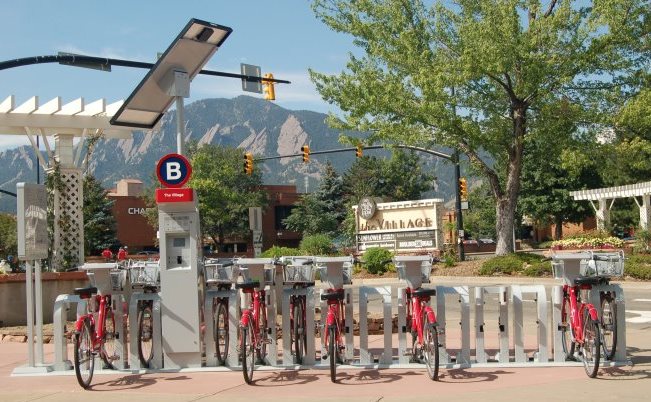
Susan Shaheen, Director of Innovative Mobility Research at Berkeley, identified BIXI, which launched in Canada in May 2009, as marking the beginning of bikesharing’s fourth generation. A major innovation attributed to the scheme is its use of mobile docking stations which allows stations to be removed and transferred to different locations. This enables stations to be relocated according to usage patterns and user demands. Another feature that could enhance future programs is the use of solar-powered stations. Not surprisingly, solar-powered stations might further reduce emissions and the need to secure access to energy grids to support operations. Fourth generation bikesharing might also consider omitting docking stations altogether which would allow users employ mobile phone technology and street furniture for bicycle pickup and drop-off. These stationless designs are both cheaper and less impactful on the environment while also offering riders higher levels of flexibility and trip customization.
Solar Powered Station at B-Cycle Boulder
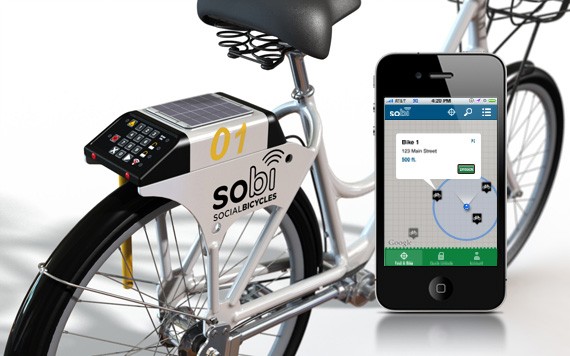
Another area of potential improvement for fourth-generation systems is in bicycle redistribution. Geo-fencing for example can directly address this problem, which has dogged the industry for years. By dividing the cycling environment into virtual zones, users can be rewarded when returning bikes to areas that most need them. These zones can be dynamically created or modified as required. The feature is a design element of Socialbicyles (SoBi) in North America.
A third feature of fourth-generation systems is the integration of bikesharing with other forms of transportation. Common payment systems across transit modes enhances usability and reciprocal apps can provide travellers with real-time data on buses, trains, taxis or even carsharing initiatives. This may lead to greater reductions in car ownership as more trips are supported by alternative forms of transport. Creating programs that coordinate meaningful integration is challenging though and often requires multiagency co-operation.
To make bikeshare accessible to more user groups, the use of electric or hybrid bikes may become more widespread in future schemes. Electric bikes overcome what researchers in MIT’s SENSEable City Labidentified as some of the primary obstacles to cycling in an urban environment; distance and topography. Examples of current schemes which have adopted this feature include the recently deployed Bycyken scheme in Copenhagen and BiciMAD in Madrid. And in relation to fleet safety and vandalism, designs which integrate GPS rather than RFID tagging can further deter theft and improve the likelihood of bike recovery. Significantly, active tracking also allows actual routes to be mapped and made available to users. Additionally, it enhances usability by allowing for the possibility of information streams such as; number of miles travelled (per trip and aggregated over time), CO2 offset, calories burned, and money saved vis-à-vis other modes. This information can be a useful way of developing relationships with users and enhancing system usage (e.g. B-Cycles, SoBi).
Socialbicycles – SoBi
The potential of crowdsourcing or participatory sensing may also become a feature of future designs. Individuals could use their personal mobile devices, typically Smartphones, to systematically report on various aspects of their environment. Essentially, the participants themselves either become a spatially distributed sensor network or act to augment sensing technology already incorporated in the bike’s design. Crowdsourcing may also take the form of collaborative map making (Capital Bikes) and route annotation (SoBi) both of which can contribute to system design, infrastructure planning, transportation modelling, and policy formation. The use of social media platforms as a deliberative component of future schemes may strengthen the co-production of services. Using technology this way could create a sense of citizenry where people have meaningful and transformative relationships with the schemes they use.
Exploiting the potential of these innovations to create systems that are integrated, open and participatory will challenge those municipalities which view their role as being primarily concerned with information dissemination and service delivery. This sufficed with traditional 3rd generation schemes which were, for the most part, insular systems designed using quite narrow definitions of efficiency and which offered little possibility for meaningful engagement either with between riders or between riders and decision makers. Next generation schemes will require that civic agencies transform their information and business processes and co-operate with each other in ways that have traditionally been problematic. And for those schemes implemented through partnerships with third parties, public agencies will need to re-think how they select providers, manage contracts, and exploit data. Understanding the response by government agencies to citizen-centric technologies and practices should tell us something about the conditions needed to support social innovation within the sector. It may also tell us how schemes with limited social value are legitimized and how such schemes might be enhanced.
In May 2014 Ubisoft released a new computer game called Watch Dogs. Having sold over 4 million copies in the first week of sales it is tipped to be the game of the year. In the game, Chicago City is controlled by a central operating system (ctOS). The super computer gets a panoptic view of the city using data from cameras and sensor networks. The information obtained is used to manage the city’s infrastructure and technology as well as to maintain a database of personal information about citizens and their activities. In Watch Dogs, a disgruntled computer hacker finds a way to access and hack the ctOS, allowing him to hijack traffic lights, the power grid, bridges and toll gates, rupture water pipes, disable surveillance cameras and access personal information about fellow citizens. The motive for causing mayhem in the city is to find a gang who were involved in his sister’s death and ultimately take down the corrupt system that runs ctOS. In this article, we take a look at some of the real dangers facing today’s cities from malicious hackers.
A Character Accesses City Infrastructure and Data in Watch Dogs
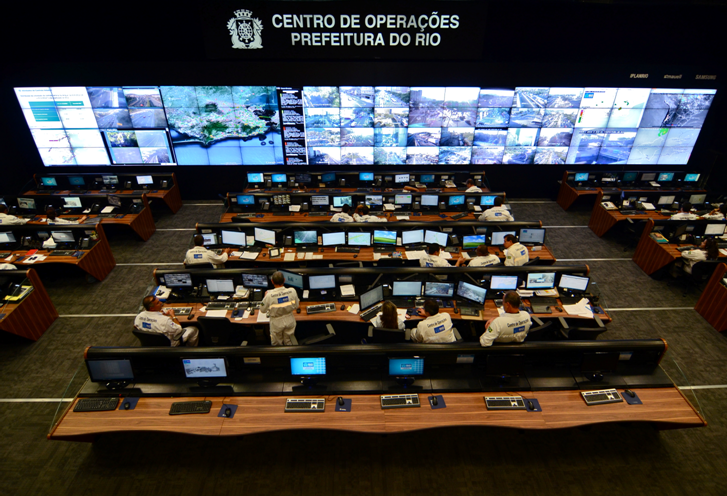
In terms of technology, Chicago, as presented in Watch Dogs is a smart city. Data is fed into the central operating system and the infrastructure of the city adapts and responds accordingly. Although much of the game is fictional, Watch Dogs draws on existing technologies and echoes what is happening today. For example, Rio de Janeiro has a large control centre which applies data analytics to social media, sensors and surveillance cameras in an attempt to predict and control events taking place in the city. Its mission is to provide a safe environment for citizens. Other cities such as Santander and Singapore have invested in sensor networks to record a range of environmental and traffic conditions at locations across the cities. Earlier this year, Intel and Dublin City Council announced that Dublin is also to get a sensor network for measuring city processes. At present many of these projects are focusing on the technical challenge of configuring hardware, designing standards and collecting, storing and processing data from the city-wide sensor networks. Projects are using the data for a range of services to control the city such traffic management (guiding motorist to empty parking spaces), energy management (dimming street lights if no one is present) and water conservation (using sensors to determine when city parks need water).
The Internet of Things & Security
The roll out of such smart city technology is enabled through the Internet of Things (IoT) which is essentially a network of objects which communicate and transfer data without requiring human-to-human or human-to-computer interaction. The IoT can range from a pace maker sending patient information to a physician, to a fridge informing its owner that the milk is low. In the smart city, sensors automatically relay data to a control centre where it is analysed and acted upon.
The Control Centre in Rio de Janeiro
While Watch Dogs raises important moral and ethical issues concerning privacy and the development of a big brother society via smart city technologies, it also raises some interesting questions about the security and reliability of the technology. In Watch Dogs, the main character can control the city infrastructure using a smart phone due to a security weakness in the ctOS. In reality, we have recently seen objects in the IoT being compromised due to weaknesses in the hardware security. Baby monitoring webcams which were accessed by hackers and demonstrations of how insulin pumps can be compromised are cases which have received media attention. Major vulnerabilities of the IoT, were seen in late 2013 and early 2014 when an orchestrated cyber attack saw 100,000 ‘things’ connected to the Internet hacked and used to send malicious spam emails. The hacked ‘things’ included smart TVs, fridges and media centres. Basic security misconfigurations and failures to alter default passwords left devices open to attack.
Even mature internet technologies such as those used in ecommerce websites are vulnerable to hacking. In May this year e-bay’s web servers were hacked leading to the loss of user data. Security flaws with the OpenSSL cryptography standard (used to transmit data securely on the Internet) came to light in April 2014 with the ‘Heartbleed’ bug. A vulnerability enabled hackers to access the short term memory of servers to capture information such as passwords or credit card details of users who recently interacted with the server. All technologies which can send and receive data are vulnerable to attack and misuse unless strict security protocols are used and kept up-to-date. Unfortunately, as the examples here highlight, it seems that the solutions to security issues are only provided after a problem or a breech has been detected. This is because it’s often an unknown bug in the code or poor coding practice which provides a way for hackers to access systems remotely. There is a reluctance to invest in thorough testing of technologies for such weaknesses. Development companies seem prepared to risk cyber attacks rather than invest in the resources required to identify problem areas.
Hacking the Smart City
The fact that all systems connected to the Internet appear vulnerable to cyber attacks is very worrying when considered in the context of smart cities. Unlike personal webcams, TVs and fridges, the technology of smart cities forms part of a complex and critical infrastructure which is used to calibrate and control a city.While governments and city authorities are generally slow to publicise attacks on their technological infrastructure, the Israeli government has acknowledged that essential services that run off sensors, such as water, electricity and banking, have been the target of numerous hacking attacks. For example, in 2013, the traffic management system for a main artery in the port city of Haifa, was hacked, causing major traffic problems that lasted for several hours. Such malicious hijacking of technology is inconvenient for citizens, costs the city financially and could also have fatal consequences. Last year, it was demonstrated that it was relatively easy to hack the traffic light system in New York City. By sending false signals regarding the traffic flow at particular junctions, the algorithm used to control the traffic light sequence could be outsmarted and fooled into thinking that a particular junction was busy and therefore adjust the green time of traffic lights in a particular direction.
City technology is built on legacy systems which have been incrementally updated as technology has changed. Security was often not considered in the original design and only added after. This makes such legacy systems more vulnerable for exploiting. For example, many of the traffic light coordination systems in cities date from the 1980s when the main security threat was physical interference. Another problem with the city technology is the underlying algorithms which can be purely reactive to the data they receive. If false data is supplied then the algorithm may produce undesirable consequences. While the discussion here has focused on sensors embedded in the city, other sources of data, such as social media are open to the same abuse. In March 2014, the twitter account of The Associated Press was hacked and a message reporting of an attack on President Barrack Obama was posted. This led to $136 billion being wiped of the NY stock exchange within seconds. This is an example of humans using bad data to make a bad decision. If the human cognition process is unable to interpret bad data, what hope do pre-programmed computer algorithms have?
As cities continue to roll out technologies aimed at enhancing the lives of citizens, they are moving towards data driven forms of governance both for long term and short term actions. Whatever type of sensor is collecting data, there is a danger that data can be biased, corrupt, played, contained errors or even be faked through hacking. It is therefore imperative for city officials to question the trustworthiness of data used in decision making. From a technical point of view, the data can be made safe by calibrating the sensors regularly and validating their readings against other sensors. From a security perspective, the hardware needs to be secured, maintained and updated to prevent malicious hacking of the device. Recognising the threat which has been highlighted by Watch Dogs, the US Centre for Internet Security (CIS) issued a Cyber Alertregarding the game stating that ‘CIS believes it is likely that a small percentage of Watch Dog players will experiment with compromising computers and electronic systems outside of game play, and this activity will likely affect SLTT (State, Local, Tribal and Territorial) government systems and Department of Transportation (DOT) systems in particular.’
In other domains, such as the motor industry there is a move to transfer functions from the human operator to algorithms. For example, automatic braking, parking assistance, distance based cruise control and pedestrian detection are becoming mainstream in-car technologies in a slow move towards vehicles which drive themselves. It is likely that managing the city will follow the same pattern and incrementally the city will ‘drive’ itself and could ultimately be completely controlled by data-driven algorithms which react to a network of sensors. Although agencies such as the CIS give some advice to minimise the risk of Cyber Attacks on cities, it seems that hacking of the smart city infrastructure is inevitable. The reliance of cities on software and the risks associated with this strategy are well known (Dodge & Kitchin, 2004; Kitchin, 2014). The problem is compounded by the disappearance of the analogue alternative to smart city technologies (Townsend, 2013). This could lead to prolonged recovery from attacks and bugs due to the total reliance on technology to run cities. Cities therefore need to consider the security risks connected to deploying and using sensors to control a city and make decisions. It is also essential that control loops and contingency plans are in place to allow a city to function during a data outage just as contingency plans are made for handling the loss of other essential services such as power and water.
References
Dodge, M., & Kitchin, R. (2004). Flying through code/space: The real virtuality of air travel. Environment and Planning A, 36(2), 195–211.
Townsend, A. (2013). Smart cities: Big data, civic hackers, and the quest for a new utopia. New York: W.W. Norton & Co.
This video introduces the Programmable City. In the video Rob Kitchin outlines the aims and objectives of the project and highlights the importance of the support received from the European Research Council (ERC). Each researcher on the Programmable City team also briefly discusses their work. The video was made by the Programmable City team in order to promote the project and the ERC.